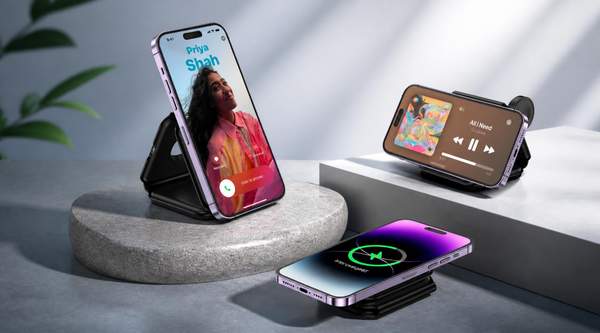
The first-generation iPhone, a device that revolutionized personal technology in 2007, launched without an app store, Bluetooth support, or even the ability to copy and paste text, according to Antler. This remarkably limited offering still captivated millions, proving that groundbreaking innovation can begin with a highly focused, core feature set.
Startups often believe they need a fully-featured product to succeed, equipped with every conceivable capability to attract users. Yet, many iconic companies began with surprisingly limited offerings, prioritizing speed and core functionality over comprehensive design.
Prioritizing a truly 'minimum' viable product allows startups to conserve resources, quickly validate core assumptions, and adapt to market feedback. This significantly increases their chances of long-term success.
Apple's strategic restraint with the iPhone in 2007, focusing solely on core communication and internet browsing, redefined personal computing. Market entry does not require a complete product offering, directly challenging the common notion that extensive features are necessary for a product to make a significant impact. It established a precedent: a focused, well-executed core can disrupt an entire industry.
What Exactly is a Minimum Viable Product?
A Minimum Viable Product (MVP) represents the version of a new product that allows a team to collect the maximum amount of validated learning about customers with the least effort. This concept forms a core component of Lean Startup methodology, which emphasizes a build-measure-learn feedback loop, starting with identifying a problem and developing an MVP, according to The Lean Startup. Crucially, this methodology integrates Customer Development guidelines, ensuring a deep understanding of user needs drives product evolution, as highlighted by ScienceDirect.
An MVP functions as a strategic instrument for rapid learning and validation, far beyond a mere simplified product. Its core purpose is to efficiently test fundamental assumptions about user needs and market demand. This approach empowers founders to gather crucial feedback without committing extensive resources to a fully developed product, de-risking the venture from its inception.
From Online Books to Global Stays: Iconic MVPs in Action
Amazon, now a global e-commerce giant, started as a simple online bookstore. Customers would place orders, and the company sourced books from distributors, according to Antler. This minimal offering rapidly validated the online retail model for books. Similarly, Facebook's initial MVP, launched in 2004, was a messaging platform exclusively for Harvard students, attracting 1,500 users within days, according to Antler. Even colossal ventures can begin with a singular, focused solution to a specific user problem.
Market validation depends on acutely addressing a core user need with minimal viable functionality. Founders who delay launch to perfect a multi-feature product actively work against the proven path to market fit, prioritizing perceived completeness over essential user validation. The success of companies like Airbnb and Atlassian, which validated core ideas using low-tech or existing resources, reveals a critical insight: the biggest barrier to startup success is not a lack of engineering prowess, but a failure to quickly and cheaply test fundamental assumptions. A strategic imperative for founders is to embrace early, iterative testing.
The Strategic Advantage of 'Minimum' in MVP
Startups leverage an MVP for two primary objectives: earning early revenue and testing their idea in the live market, according to Antler. This focused approach allows companies to gather real-world data on user interaction and market acceptance. While Antler suggests an MVP is ready for 'the market and customer' to gain value, implying broader readiness, its strategic application often involves a more contained deployment to specific segments.
An MVP should be provided to a small subset of customers across a range of demographics, not all customers, according to Universitylabpartners. This targeted deployment confirms that while an MVP offers value, its initial rollout is strategically narrow, allowing for precise feedback and iterative improvements. By focusing on a single core feature and targeting specific early adopters, MVPs efficiently validate market demand, generate early revenue, and optimize resource allocation for future development. This controlled release minimizes risk while maximizing learning.
Why a Lean Launch is Your Best Bet
A lean launch strategy, centered on a Minimum Viable Product, protects critical startup resources. It allows founders to avoid over-investing in features that may not resonate with the market, conserving capital and development time. The true power of an MVP lies not just in its speed to market, but as a precise instrument for de-risking an idea through targeted customer feedback and iterative learning, rather than a broad market launch. This approach fundamentally shifts product development from speculation to validated progress.
Strategic MVP deployment conserves critical resources while gaining invaluable real-world insights. It proves that less can indeed be more in early-stage product development. Prioritizing essential functionality allows companies to quickly adapt their offerings based on direct user engagement, ensuring a more responsive and sustainable product evolution. This agility is a competitive differentiator.
Common Questions About MVPs
What are the key steps in launching an MVP?
Launching an MVP typically involves identifying a core problem, defining the simplest solution with a single key feature, building that feature, and then testing it with a small group of target users. This iterative process prioritizes learning from real-world usage to guide subsequent development phases.
How do you validate an MVP?
MVP validation occurs through direct user feedback, usage analytics, and conversion rates among early adopters. Founders collect qualitative data through interviews and quantitative data from product engagement, using these insights to confirm or refute initial assumptions about market need and user value.
What is the difference between MVP and prototype?
A prototype is primarily a non-functional or partially functional model designed to test specific concepts, user interface flows, or technical feasibility. In contrast, an MVP is a functional, deployable product with just enough features to solve a core problem for early customers and gather market validation.
If startups consistently embrace the discipline of a truly minimum viable product, focusing on rapid validation and iterative learning, they will likely navigate competitive landscapes more effectively and achieve sustainable growth.