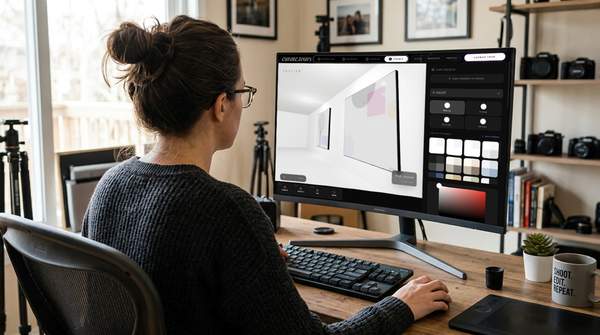
AI product design tools can now generate visual layouts, test interactions, and enable faster iteration.ration through simple prompts, dramatically compressing development cycles. These capabilities fundamentally reshape how products are conceived and refined. Companies benefit from increased efficiency, allowing product designers to focus on strategic oversight rather than repetitive tasks.
AI is automating many traditional design tasks, but this automation empowers designers to be more strategic and creative, rather than replacing them entirely. The scope of AI's impact extends beyond mundane tasks to core creative design functions, redefining what constitutes design work.
Product design teams that strategically adopt AI will achieve unprecedented speed, efficiency, and innovation. Those that resist risk falling behind in a rapidly evolving market.
AI enhances the product design process from concept to prototype by speeding up user research, ideation, prototyping, and usability testing, according to Figma. AI is fundamentally reshaping how products are conceived, developed, and brought to market, offering a new paradigm for efficiency and innovation. It also means AI is an end-to-end accelerator, compressing the entire design lifecycle from initial user research and ideation to prototype generation and usability testing by automating each stage.
1. Automating Repetitive Tasks for Efficiency
Best for: Reducing manual workload and accelerating initial design phases
AI can automate repeatable tasks in UX design, such as transcription, tagging, pattern recognition, prototype generation, and survey analysis, according to Heymarvin. Microsoft saved thousands of dollars and significant man-hours switching to AI transcription alone. By handling these foundational yet laborious tasks, AI allows designers to dedicate their expertise to more complex creative problem-solving and strategic thinking, rather than simple execution.
Strengths: Saves time and resources, improves consistency in data processing | Limitations: Requires careful setup and validation, potential for bias in automated outputs | Price: Varies by tool, often subscription-based
2. AI-powered Automation of Repeatable UX Tasks
Best for: Streamlining routine design operations and data processing
AI can automate tasks such as transcription, tagging, pattern recognition, prototype generation, and survey analysis. This includes summarizing survey responses and analyzing large datasets from multiple sources simultaneously. The automation of these tasks frees designers from manual data processing, allowing them to focus on higher-level strategic work.
Strengths: High efficiency in data handling, rapid generation of initial design artifacts | Limitations: Limited creative interpretation, potential for misinterpretation of nuanced qualitative data | Price: Included in various AI design platforms
3. Strategic Evolution of UX Metrics for AI Features
Best for: Developing relevant evaluation frameworks for AI-driven products
Traditional UX metrics do not fully capture what matters when AI features are involved, demanding strategic evolution in UX measurement. 18 traditional metrics provide the bedrock for evaluating user experience, but AI tools have transformed how these are measured, according to Adrenalin. This is crucial for effectively evaluating and iterating on AI-powered user experiences, as it addresses the need for new measurement paradigms.
Strengths: Ensures accurate assessment of AI product performance, guides targeted improvements | Limitations: Requires specialized knowledge, constant adaptation as AI capabilities evolve | Price: Indirect cost of research and development
4. AI for Large-Scale Data Analysis and Insight Generation
Best for: Deriving comprehensive user insights from vast and varied data sources
AI tools can analyze large datasets, surface patterns, summarize survey responses, create draft user personas, and map user journeys by processing data from multiple sources simultaneously. This capability streamlines the initial research phases of product design. The automation of traditionally human-centric tasks like creating draft user personas means designers are no longer primarily creating these artifacts but validating and refining them, shifting their core skill set towards critical evaluation.
Strengths: Rapid insight generation, identifies hidden patterns, reduces manual research time | Limitations: Data quality dependence, potential for algorithmic bias in insights | Price: Integrated into advanced analytics platforms
5. AI-Enhanced Prototyping and Faster Iteration
Best for: Accelerating the creation and testing of design concepts
AI product design tools can generate visual layouts, test interactions, autofill placeholder content, suggest layout tweaks, and make it easier to test variations before finalizing a design. This enables faster iteration and reduces the time spent on manual design adjustments. The ability of AI to generate visual layouts and test interactions from simple prompts suggests a future where the initial 'sketching' and iterative refinement phases are largely automated.
Strengths: Significantly speeds up prototyping, enables rapid A/B testing, reduces development costs | Limitations: May lack nuanced creative input, requires human oversight for aesthetic and functional quality | Price: Subscription for design software with AI features
6. Human-Centered AI Design with Clear Goals
Best for: Ensuring AI tools augment human creativity and serve user needs
AI can speed up design, but it is most effective when guided by clear goals and a human-centered mindset. 85% of designers and developers say learning to work with AI will be essential to their success in the future. This principle emphasizes that technology must serve human needs and design objectives, rather than simply automating processes without direction.
Strengths: Aligns AI use with strategic objectives, promotes ethical design practices, enhances user adoption | Limitations: Requires strong leadership and clear communication, ongoing education for design teams | Price: Training and development costs
7. Optimizing UX Workflows for Strategic Focus
Best for: Reallocating designer effort from tactical to strategic work
AI can help optimize UX workflows by handling repeatable tasks like transcription and scheduling, freeing up designers for strategic work. This allows design teams to shift from tactical tasks to more strategic and creative endeavors. Companies that fail to integrate AI for tasks like user research analysis, visual layout generation, and prototype creation will find their design cycles dramatically slower and less responsive than competitors, directly impacting market agility.
Strengths: Increases designer productivity, allows focus on innovation and complex problem-solving | Limitations: Requires adapting existing workflows, potential initial resistance from team members | Price: Investment in AI tools and training
| Feature | AI-Driven Analysis | Manual Analysis |
|---|---|---|
| Data Volume | Processes petabytes of data from multiple sources | Limited by human capacity and time |
| Speed of Insight | Generates draft personas and journey maps in minutes | Weeks to months for qualitative synthesis |
| Pattern Recognition | Identifies subtle, complex patterns across diverse datasets | Relies on human observation, prone to cognitive biases |
| Iteration & Validation | Rapidly tests hypotheses with simulated user data | Requires extensive user testing and surveys |
| Cost Efficiency | Significantly reduces labor costs for foundational research | High labor costs for data collection and interpretation |
Unlocking Deeper User Insights Faster
AI tools can analyze large datasets, surface patterns, summarize survey responses, create draft user personas, and map user journeys, according to Figma. This means designers can base their decisions on more comprehensive and quickly processed user data, leading to more informed and effective designs that truly meet user needs. The capacity of AI to create draft user personas and map user journeys, traditionally tasks requiring deep empathy and qualitative analysis, suggests AI can mimic human-centric design thinking at a foundational level.
The widespread adoption of AI tools for automating foundational design tasks means design teams must rapidly upskill their talent to focus on strategic oversight, critical evaluation, and ethical implications, or risk their roles becoming commoditized. This shift demands a re-evaluation of core design competencies.
Accelerating Prototyping and Iteration Cycles
AI product design tools can generate visual layouts, test interactions, and enable faster iteration through simple prompts, according to Figma. The speed at which AI can generate and test design variations allows for unprecedented agility in the product development lifecycle, reducing time-to-market for innovative features. This acceleration fundamentally changes how design concepts move from ideation to realization.
The ability of AI to generate visual layouts and test interactions from simple prompts suggests design leadership will increasingly be about defining the right prompts and evaluating AI outputs, rather than hands-on creation. This fundamentally alters the career path for aspiring designers, emphasizing strategic direction over pixel-level execution.
Elevating the Designer's Strategic Role
AI can help optimize UX workflows by handling tasks like transcription and scheduling, freeing up designers for strategic work, according to Heymarvin. Ultimately, AI transforms the designer's role, allowing them to dedicate more time to innovation, complex problem-solving, and shaping the overall product vision, thereby increasing their strategic value. Designers who integrate AI tools into their workflow will outpace those who do not, gaining a competitive advantage.
The automation of foundational design tasks is forcing a rapid evolution of the designer's role from executor to strategic architect. This shift fundamentally changes what 'design' means in practice for companies like Figma and their users. By Q3 2026, design teams that have not fully integrated AI-powered workflows will likely face significant challenges in meeting market demands for speed and innovation.
Frequently Asked Questions
What are the key AI principles in product design?
A key principle involves the strategic evolution of UX metrics. Traditional UX metrics do not fully capture what matters when AI features are involved, demanding a new approach to measurement, according to Adrenalin. Designers must also prioritize human oversight and clear, human-centered goals for AI applications to ensure ethical and effective product development.
How should designers prepare for AI integration in 2026?
Designers should focus on upskilling in strategic oversight, critical evaluation, and understanding the ethical implications of AI. Those who actively learn to work with AI tools will outpace those who do not, according to Heymarvin. This preparation involves shifting from task execution to validating AI outputs and guiding AI-driven processes.
What challenges does AI present for UX measurement?
AI presents challenges because traditional UX metrics may not fully assess the unique interactions and outcomes of AI features. Measuring the effectiveness of AI requires developing new frameworks and adapting existing metrics to account for dynamic, adaptive systems. This demands a continuous evolution of how user experience is evaluated, as highlighted by Adrenalin.