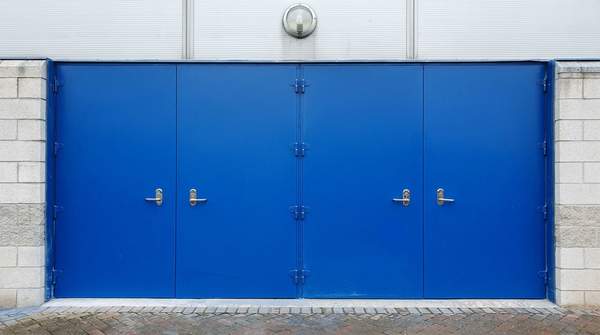
A severe weather alert pings on your screen. As rain lashes against the windows, your thoughts turn to the most vulnerable point of your facility: the warehouse loading bay. The standard industrial roller door, built for access and security, offers little resistance to the quiet creep of rising floodwater.
For any facility manager or business owner, this scenario is a significant and growing operational risk. It is a vulnerability that specialized engineering firms like Flood Control International have spent decades solving, transforming potential weak points into fortified defenses.
How Do You Effectively Flood-Proof a Commercial Roller Door?
By design, standard roller shutter doors are not watertight. Gaps at the base and along the side tracks become easy pathways for water to get in, which can quickly lead to costly inventory damage and business interruption.
A last-minute sandbag wall is an unreliable fix for such large openings. Truly effective roller shutter flood protection comes from a purpose-built, engineered flood barrier solution for roller door openings that creates a complete seal.
This is why bespoke flood engineering is so critical. Instead of offering a one-size-fits-all product, specialists like Flood Control International design systems tailored to the exact dimensions and operational needs of a specific opening. Their solutions include automatic drop-down flood barriers or robust rolling flood gates — among the best floodgates for large openings available — all permanently installed to integrate seamlessly with the existing structure.
The aim is to create a perfect, watertight seal against pre-installed side channels, living up to the company promise: "The Water Stops Here®."
Are Automatic Flood Barriers for Roller Doors Better Than Manual Ones?
When you are protecting high-value assets or critical infrastructure, the choice between manual and automatic flood barriers comes down to risk. Manual barriers require people to be present, take time to deploy, and leave room for error during an emergency.
In contrast, automatic flood barriers are passive systems that work without human or electrical power, activating on their own when floodwater appears — a quality that puts them among the best passive floodgates for sites that can't rely on someone being there in time.
This passive flood protection is quickly becoming the standard for sites where failure just isn't an option. A self-closing flood barrier, for example, ensures protection is in place 24/7, whether staff are on-site or even aware of an impending threat.
That is why organizations responsible for critical infrastructure, including Flood Control International clients like all of the UK's nuclear power stations and National Grid, increasingly specify automatic systems. They guarantee uninterrupted service and remove the unpredictable variable of human response time.
How Drop-Down and Rolling Flood Gates Integrate with a Building
Architects and property owners often worry that flood defenses will be unsightly or obstruct access. Modern engineered solutions, however, are designed to be discreet, making them some of the best options for hidden passive flood protection on the market today.
A drop-down flood barrier, for instance, is usually housed in a soffit above the roller door opening, so it stays completely hidden during normal operations. When triggered by rising water, it lowers automatically into position to form a seal.
Similarly, rolling or sliding flood gates can be designed to retract into a wall cavity or sit unobtrusively to one side. This focus on aesthetic and operational harmony means that adding commercial flood gates for doors does not have to compromise a building's design or daily logistics. Access stays clear and the visual impact is minimal until the moment protection is needed.
Real-World Outcomes: Protecting Over $50 Billion in Assets
The true test of any flood defense system is its performance in the real world. With over 2,400 completed projects since 1994, Flood Control International has a long track record in critical infrastructure protection. The company has been trusted to protect property valued at over $50 billion, a figure that highlights the high-stakes nature of its work.
The firm's client list includes some of the world's most sensitive and valuable facilities. In addition to its work with the entire UK nuclear power station fleet, it has designed and installed flood protection for the European headquarters of Google, Facebook, and Twitter.
This extensive experience is backed by a £10 million flood-specific professional indemnity insurance policy, giving clients another layer of confidence in their custom flood engineering.
What is the Typical Cost of Installing a Roller Door Flood Barrier?
Figuring out the price for a custom industrial flood door is not as simple as quoting a standard product. The investment is completely custom and depends on several factors:
- Size of the Opening: Larger and wider openings in industrial loading bays naturally require more substantial engineering and materials.
- Type of Barrier: An automatic, self-closing flood barrier will have a higher initial cost than a system that has to be deployed manually.
- Site Complexity: The existing structure, ground conditions, and integration needs all shape the final design and installation costs.
It is more helpful to see it as an investment in risk mitigation rather than a cost. When you weigh it against the potential losses from a single flood, which can include ruined equipment, lost inventory, and long operational downtime, the ROI on a professionally engineered flood defense system becomes obvious. A detailed consultation with specialists is the only way to get a precise, custom quote based on a full site assessment.
The Competitive Landscape for Industrial Flood Defence
The flood barrier market has several key players, and each has different specializations. The field ranges from providers of temporary, rapid-deployment barriers to firms that focus on large-scale civil projects. When you are looking for a system for an industrial loading bay flood defence, understanding these differences is crucial.
Flood Control International holds a unique place in this competitive field. A quick comparison shows their specific focus:
- Custom Engineering: While many providers offer standard products, Flood Control International's core strength is its in-house team of technical specialists who design completely bespoke solutions for any flood threat.
- System Specialization: The company excels in permanent, passive flood protection for critical facilities, unlike competitors who may focus more on temporary or manual barriers for less sensitive sites.
- Proven Track Record: With a history going back to 1994 and a portfolio protecting some of the world's most vital assets, their experience offers a level of dependability that is hard to match.
The Bottom Line
For facility managers, the question is not just whether to protect their most vulnerable entry points, but how to do it with engineered certainty. As weather patterns grow more unpredictable, a proven, automatic system is no longer just a reactive measure, it is a core part of strategic business resilience. For any organization looking at its flood risk, the next step is a professional site survey to see what tailored protection can be put in place.
To take the next step towards engineered flood protection, contact Flood Control International at https://floodcontrolinternational.com/ to schedule a professional site survey.