An exhibition organised through an open call starts long before anyone decides where the selected work will hang. Submissions have to arrive, jurors need a way to assess them and the chosen pieces eventually need to become a show rather than remain a folder of accepted entries.
curate.tours extends its 3D exhibition platform into that earlier part of the process through the Gallery tier. Its institutional Open Call Portal and Jury Desk support art societies and painting guilds moving from submissions and scoring towards a published virtual exhibition.
Start With the Open Call
An open call establishes the pool from which the exhibition will be built. curate.tours supports publishing an open call and collecting submissions from members and non-members, bringing the intake stage into the same platform used for the eventual 3D presentation.
That gives the organising team a defined route from receiving work to developing the exhibition. The process begins with entries rather than with an empty gallery waiting to be filled.
For societies that run recurring juried shows, selection and presentation can remain part of one broader process. Once entries have been assessed, the chosen work can continue towards the 3D exhibition stage rather than ending the digital workflow at a list of results.
Give Jury Review Its Own Structure
Once submissions are in, the next job is deciding which works should advance. curate.tours includes a Jury Desk that allows jury members to be assigned to score entries.
The platform documents four assessment criteria: Originality, Technique, Concept and Curatorial Fit. Separate criteria give jurors a structured way to consider different qualities of an entry rather than reducing every decision to one undifferentiated score.
Curatorial Fit also keeps the eventual exhibition in sight. It gives the review process a criterion concerned with how an entry belongs within the show being assembled, alongside qualities of the individual work.
Move From Scores to a Curated Selection
A jury score contributes to a decision about which works will form the exhibition. Once selections have been made, the task changes from evaluating entries to preparing the chosen work for public presentation.
That transition is central to the institutional use case for curate.tours. The same broader platform that supports the Open Call Portal and Jury Desk also provides the 3D exhibition tools used to turn the selection into a finished virtual show.
For an organising team, the workflow therefore has a visible destination. Submission intake and jury review are stages in producing an exhibition rather than isolated administrative tasks.
Build the Exhibition Around the Selected Work
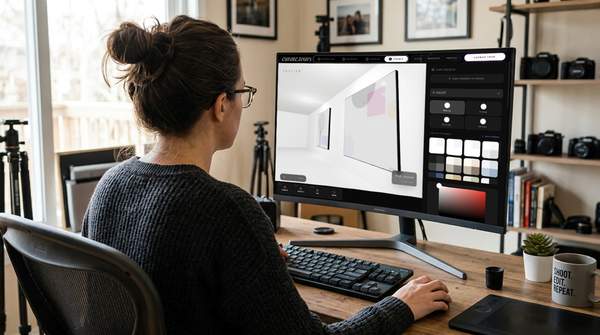
curate.tours supports custom vector floorplans, high-resolution artwork placement, 3D staging elements and atmospheric lighting for the final virtual exhibition.
An art society might use separate areas for different sections of a show, while a smaller juried exhibition could use a more compact arrangement that keeps the accepted work together. The available exhibition tools give organisers control over how the final selection appears once judging is complete.
This stage shifts the focus from scoring to presentation. The question is no longer which entries should advance, but how the accepted work should be assembled into the exhibition the audience will see.
Let the Exhibition Become the Public Outcome
The work behind an open call is largely invisible to the eventual visitor. What the audience encounters is the selected exhibition, and curate.tours allows that work to be staged as an interactive 3D show that can be shared online.
Instead of ending the digital process when judging is complete, the organisation can carry the selection into a space designed for viewing. The exhibition becomes the public-facing result of the call and jury process.
For an annual society exhibition, the virtual gallery can supplement a physical show or operate as an online exhibition in its own right. That gives organisations a way to take the work selected through the open call into a presentation visitors can enter online.
Follow a Five-Stage Route From Call to Exhibition
For an organisation planning a juried virtual show, the supported workflow can be understood in five stages:
- Publish the open call: establish the invitation for artists to submit work.
- Collect submissions: receive entries from members and non-members.
- Assign jury members: give selected jurors access to the review stage.
- Score and select: assess entries using Originality, Technique, Concept and Curatorial Fit, then determine which works will advance.
- Build and publish the exhibition: arrange the selected work inside a custom 3D space and make the finished show available online.
The progression keeps administration connected to presentation. Entry collection and jury review determine which work moves forward, while the exhibition builder provides the environment in which that selection becomes public.
Keep the Institutional Workflow Pointed Towards a Show
Open-call software can easily become defined by forms, scores and submission handling. For an art society or painting guild, however, those functions support a larger objective: producing an exhibition from the work that survives the selection process.
That is where the Gallery-tier offer fits the wider identity of curate.tours. The Open Call Portal and Jury Desk handle the earlier stages, while the platform’s 3D exhibition capabilities carry the selected work into the public presentation.
The connection gives the institutional offer a specific purpose. It brings the administrative and curatorial stages of a juried show into a workflow built around the exhibition that follows.
Frequently Asked Questions
Can curate.tours collect submissions for an open call?
Yes. curate.tours supports an institutional Open Call Portal through its Gallery tier and documents the ability to collect member and non-member submissions. The selected work can then move towards a 3D virtual exhibition within the wider platform.
Does curate.tours include tools for jury review?
Yes. curate.tours includes a Jury Desk within its Gallery-tier institutional offer. Jury members can be assigned to score submitted entries as part of the selection process.
What criteria can jurors score in curate.tours?
curate.tours documents four jury criteria: Originality, Technique, Concept and Curatorial Fit. These provide separate categories for assessing different aspects of a submitted work.
Can selected works become a 3D exhibition in curate.tours?
Yes. curate.tours combines its Open Call and jury functions with 3D exhibition-building capabilities. Selected works can move into a custom virtual space where organisers can prepare the final exhibition for online presentation.
Which curate.tours plan includes Open Call tools?
The Gallery tier is the curate.tours plan documented as including the institutional Open Call Portal and Jury Desk. This is the relevant tier for art societies and painting guilds planning to use those functions.
Carry the Open Call Through to the Exhibition
A juried show involves choosing the work and deciding how that selection should meet its audience. curate.tours connects those stages by pairing institutional submission and jury tools with the 3D exhibition environment used to stage the finished show.
Review the Gallery-tier Open Call and Jury Desk features when planning how your organisation will take an upcoming call from submitted work to a published 3D exhibition.