Construction and demolition contractors regularly face projects involving different materials, structures, and operating conditions.
A single excavator may be expected to break concrete, process demolished material, remove structural steel, or prepare a site for its next phase of development. Having access to suitable attachments gives contractors more flexibility when approaching these varied requirements.
However, the benefits of an excavator depend partly on selecting attachments that match the work. Hydraulic hammers, concrete pulverizers, demolition shears, and screening buckets each serve different purposes. Understanding their applications can help contractors make better equipment decisions and organize their operations more effectively.
EFI Demolition Equipment supplies a range of demolition machinery and excavator attachments that contractors can consider when expanding or updating their equipment inventory.
1. Select Hydraulic Hammers for Demanding Breaking Applications
Concrete breaking is a common requirement in demolition and construction. Removing foundations, breaking slabs, and processing hard surfaces can require equipment designed to deliver repeated impact force.
Hydraulic hammers are developed for these applications. Connected to an excavator's hydraulic system, they use a striking mechanism to fracture hard materials through repeated blows.
For contractors, the attachment offers a specialized approach to breaking concrete and other suitable materials. Rather than relying on general-purpose excavation equipment alone, operators can use a hydraulic breaker designed for the task.
Selecting the appropriate hammer requires careful consideration of the excavator's operating weight, hydraulic flow, operating pressure, and the material being processed.
The attachment must also be appropriate for the jobsite conditions and intended working method. Contractors should review manufacturer recommendations and operating requirements before purchasing or using a particular model.
EFI's hydraulic hammer equipment options provide contractors with another category to explore when planning concrete-breaking and demolition work.
2. Use Concrete Pulverizers for Material Processing
Breaking a concrete structure is not necessarily the final step in demolition. The resulting material may need to be crushed, reduced in size, and separated for handling or further processing.
Concrete pulverizers are designed for crushing applications. Their jaws apply force to concrete, helping reduce larger pieces into smaller sections. Depending on the design, they can also help separate reinforcing steel from demolished concrete.
This makes pulverizers worth considering for projects where processing the removed material is an important part of the work.
For example, a contractor demolishing reinforced concrete may need equipment suited to both structural removal and subsequent material reduction. A suitable pulverizer can support that processing stage.
Buyers should examine the attachment's jaw design, opening dimensions, crushing specifications, and intended machine weight range. They should also confirm whether the model is suitable for the reinforcement and material thickness involved.
Selecting a pulverizer based on its actual application helps contractors avoid treating all concrete-processing equipment as interchangeable.
3. Choose Demolition Shears for Suitable Steel Processing
Structural steel requires a different demolition approach from concrete. Contractors handling metal frameworks, industrial structures, or scrap processing may need attachments designed specifically for cutting.
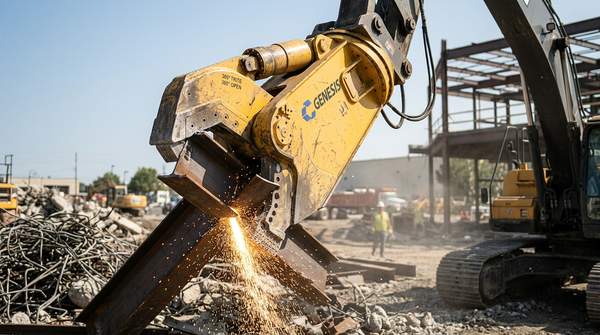
Hydraulic demolition shears use powered jaws to cut suitable metal materials. Their application makes them relevant to contractors who regularly process steel structures or prepare metal components for subsequent handling.
The right shear depends on the material type, thickness, cutting requirements, and excavator specifications.
Buyers should compare jaw configuration, cutting capabilities, hydraulic requirements, and attachment weight. They should also verify that the selected model is appropriate for the excavator and intended operating conditions.
A shear designed for one category of work may not be the right choice for another. Reviewing manufacturer specifications is therefore essential before purchase.
For businesses involved in both structural demolition and material recovery, evaluating suitable shears can help identify equipment that supports their particular processing requirements.
4. Consider Screening and Crushing Buckets for On-Site Processing
Material handling is another important part of construction and demolition operations. Contractors may need to separate, process, or reduce materials before moving them elsewhere.
Screening and crushing buckets offer specialized attachment options for certain material-processing applications.
Screening buckets are designed to separate materials according to their size and the equipment's screening configuration. Crushing buckets are intended to reduce suitable materials through a crushing mechanism.
These attachments may be relevant to contractors who want to explore processing options directly at the jobsite. Depending on the application, they can support material management and reduce the need to handle certain materials through multiple separate stages.
However, not every bucket is appropriate for every material. Contractors should consider the material's characteristics, moisture content, desired output, machine specifications, and attachment capabilities.
Understanding these requirements before purchasing helps determine whether a screening or crushing bucket is a practical addition to the equipment fleet.
5. Match Attachments to the Excavator and Project Requirements
Even the most appropriate attachment category can become an unsuitable investment if it does not match the excavator.
Hydraulic flow, operating pressure, machine weight, mounting dimensions, and pin measurements all influence attachment compatibility.
Contractors should establish these specifications before purchasing. They should also consider the machine's intended operating environment and whether the attachment will be used regularly or only for specialized projects.
EFI Demolition Equipment offers custom mounts and pins through its fabrication capabilities. This can help address certain mounting requirements when a buyer identifies an attachment that otherwise suits the intended application.
The company's inventory includes new and used equipment, allowing contractors to explore different purchasing options. Equipment sourcing assistance is also available for buyers searching for machinery that is not listed in the current inventory.
These capabilities are useful considerations for businesses looking to expand their equipment choices without limiting their search to one particular attachment configuration.
Build a More Versatile Equipment Inventory
The right excavator attachments help contractors approach different project requirements with more specialized equipment. Hydraulic hammers address breaking applications, pulverizers support concrete processing, shears handle suitable steel-cutting work, and screening or crushing buckets provide additional material-processing options.
The key is to choose equipment according to the job rather than purchasing attachments without a clear operational purpose.
EFI Demolition Equipment offers demolition attachments, construction machinery, custom mounting solutions, and equipment sourcing assistance. Contractors can explore the available inventory and discuss their excavator specifications to identify equipment suited to their next project.
Making informed attachment decisions can help construction businesses develop an equipment inventory that supports the actual work they undertake.