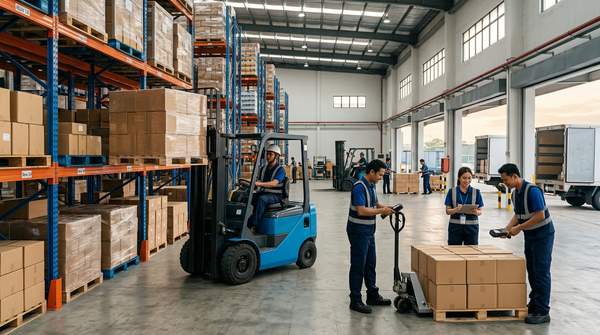
Southeast Asia presents substantial opportunities for e-commerce businesses, but regional expansion also introduces operational complexity. The region's major markets share geographic proximity while differing in logistics infrastructure, consumer behavior, transportation networks, and market conditions.
For businesses planning to sell across multiple Southeast Asian markets, the challenge is therefore not simply finding a way to ship products. It is creating an operational system capable of coordinating orders, inventory, warehousing, fulfilment, and distribution.
IDEALONE is positioned around this challenge as an order management and logistics system designed for Southeast Asian e-commerce, with distribution and warehousing solutions. Its regional focus provides a useful starting point for understanding why e-commerce expansion requires more than a delivery provider.
Southeast Asia Is Not One Uniform E-Commerce Market
Regional expansion can sometimes be described as though Southeast Asia were a single market.
Operationally, it is not.
Businesses may encounter different consumer preferences, infrastructure conditions, payment environments, transportation networks, marketplace ecosystems, and regulatory requirements from one country to another.
J&T Express has similarly observed that there is no single fulfilment model that can simply be applied across Singapore, Indonesia, the Philippines, Thailand, Malaysia, and Vietnam.
That distinction matters because logistics strategies need to reflect local conditions.
A process that works efficiently in one market may require adjustment somewhere else.
More Markets Can Mean More Operational Variables
Entering another country can expand a company's customer base, but it can also add another layer to the operating model.
The business may need to determine where inventory should be held, how orders should be processed, how products will reach customers, and how exceptions will be managed.
If every market operates independently, the organization can end up with several separate processes.
That may be manageable during the early stages of expansion, but fragmentation can become increasingly difficult as order volumes and product ranges increase.
This is where centralized order management becomes relevant.
Rather than viewing each order as an isolated transaction within one market, businesses can build a broader operational framework around the entire order lifecycle.
Multi-Channel Selling Adds Another Layer
Regional expansion is only one source of complexity.
The number of sales channels can also increase.
A business entering Southeast Asia may sell through its own website while participating in marketplace ecosystems and other digital channels. Orders can therefore arrive from multiple sources even when the underlying inventory is the same.
Without coordinated information, employees may have to monitor several systems and manually reconcile order activity.
Recent research into Southeast Asian OMS requirements points to inventory mismatches, fragmented systems, and limited order visibility as challenges that can emerge as businesses scale.
An integrated order management approach is designed to reduce this fragmentation by bringing order information into a more organized operational workflow.
Inventory Positioning Becomes More Important
Selling across multiple markets also raises an important question: where should inventory be located?
A business can store products centrally and distribute them outward, or it can position inventory closer to important customer markets. The appropriate approach depends on the products, demand patterns, logistics network, and overall operating model.
There is no universal answer.
What matters is that businesses understand their inventory position and can connect it to incoming orders.
A customer order should not exist independently from information about available stock.
If inventory data is difficult to access or frequently outdated, employees may spend significant time checking whether an order can actually be fulfilled. Inaccurate inventory can also create avoidable customer-service problems.
This makes inventory visibility a fundamental part of regional e-commerce operations.
Warehousing Becomes Part of the Strategy
Once a business begins using multiple warehouses or fulfilment locations, warehouse management becomes closely connected to its broader e-commerce strategy.
Warehouses need to receive, store, locate, pick, prepare, and release products for distribution.
At the same time, management needs to understand how inventory is distributed across locations.
This is not simply a property question.
The warehouse is part of the customer journey because the speed and accuracy of warehouse operations can influence what happens after an order is placed.
Industry discussions about Southeast Asian logistics have highlighted the importance of fulfilment infrastructure and tight inventory processes as online commerce expands.
For businesses operating regionally, technology can help connect warehouse activity with the larger order-management process.
Distribution Is More Than the Last Mile
The term “delivery” can make logistics sound like a single activity.
In practice, distribution involves a sequence of movements and decisions between fulfilment and the customer.
Southeast Asia's geography makes this especially significant. Businesses can serve dense metropolitan areas, provincial communities, islands, and other locations with very different transportation characteristics.
The last mile is also highly visible to customers. Delays or poor tracking can affect perceptions of the retailer even when the underlying issue occurs within the logistics network.
McKinsey's research into Southeast Asian e-commerce identified delivery delays, slow service, poor customer service, damaged packages, and poor tracking among common logistics complaints.
For businesses, that reinforces the importance of treating distribution as part of the broader customer experience.
Visibility Helps Connect the Regional Operation
The larger and more geographically distributed an e-commerce operation becomes, the more difficult it can be to understand what is happening without organized information.
Management may want to know where orders are coming from, where inventory is held, what is awaiting fulfilment, and which orders require attention.
Employees may need more specific information about individual orders.
Warehouse teams need operational instructions.
Customer service teams may need order status information.
These requirements are different, but they are connected.
An order management and logistics system can provide a common operational framework for organizing information across these activities.
That is an important aspect of IDEALONE's positioning. Rather than focusing narrowly on the delivery stage, the brand's proposition encompasses order management, logistics, distribution, and warehousing.
Growth Can Expose Operational Weaknesses
Expansion often reveals problems that were less noticeable when the business was smaller.
Manual processes that once saved money may become bottlenecks. Spreadsheets that worked for a limited inventory may become difficult to maintain. Employees who previously knew every order personally may no longer have enough time to track everything manually.
The result can be inconsistent information and slower decision-making.
Growth therefore creates a technology question as well as a sales question.
Can the existing operational structure support more customers, products, markets, and orders?
If the answer is uncertain, improving the underlying system can become an important part of the expansion strategy.
Regional Technology Should Support Regional Thinking
The value of an e-commerce technology platform is partly determined by how closely it matches the business environment.
For a company operating in Southeast Asia, regional context matters.
A system should support the organization's actual order flow, inventory structure, fulfilment model, warehouse configuration, and distribution requirements. It should help teams understand operations without forcing them to treat every market as completely disconnected.
That does not mean every Southeast Asian business needs the same system.
Instead, it means decision-makers should evaluate technology according to the complexity they actually face.
What Businesses Should Ask Before Expanding
Before entering another market, e-commerce operators can benefit from asking several practical questions.
Where will inventory be stored? How will orders be captured? How will stock remain accurate across channels? Which warehouse will fulfil a particular order? How will distribution be coordinated? What happens when an order is delayed or returned?
These questions move the discussion beyond marketing plans and into operational readiness.
They also highlight why logistics should be considered early rather than treated as something to solve after sales begin.
Building a More Connected Regional Operation
Southeast Asian e-commerce offers considerable opportunity, but regional growth requires businesses to think beyond storefronts and advertising.
Every additional order creates an operational requirement. Every additional market introduces more variables. Every additional sales channel creates another source of demand that needs to connect with inventory and fulfilment.
That is why order management, warehousing, distribution, and logistics should be considered parts of one broader operating system.
IDEALONE's positioning around these interconnected functions is particularly relevant to businesses looking for a more structured approach to Southeast Asian e-commerce operations.
Regional expansion does not have to mean creating an entirely separate operational process for every market. With the right systems and processes in place, businesses can work toward greater visibility and coordination across the order journey.
Ultimately, successful regional e-commerce is not only about reaching more customers. It is about building an operation capable of serving those customers consistently. The stronger that foundation becomes, the better positioned a business is to manage the complexity that comes with growth.